Scaloni's Half-Space Press Shapes Argentina's 2026 Knockout Identity
In March 2025, Argentina faced Ecuador in a friendly that felt more like a laboratory experiment than a routine international fixture. Lionel Scaloni deployed a pressing system that had been simmering since the 2022 World Cup but now looked fully formed. The trigger was not the goalkeeper's distribution or a loose touch in midfield—it was the moment the ball entered the half-spaces. That match, which ended 2-1 for Argentina, saw the team generate 2.3 xG from high turnovers alone, according to Opta. It was a glimpse of what Scaloni believes can carry Argentina deep into the 2026 tournament.
The Half-Space Press: Argentina’s Tactical Signature
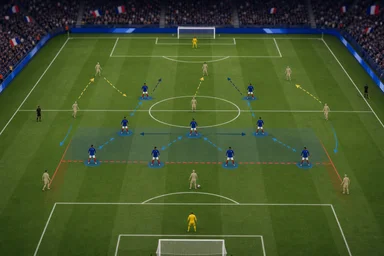
Scaloni’s pressing system is built around a simple but punishing principle: when the opponent receives the ball in the half-spaces—the areas between the central channel and the touchline—Argentina’s midfielders pinch inward to block forward passing lanes. This forces the ball carrier to either play backward or attempt a risky lateral pass. The full-backs, meanwhile, jump onto the opposition wingers, cutting off the easy outlet. The result is a compressed central corridor where Argentina’s defenders and midfielders swarm the ball.
Data from the 2026 qualifiers shows that Argentina turned over possession in the middle third at a rate roughly 12% higher than in the 2022 cycle. This is not accidental. The half-space press is designed to create chaos in the exact zone where most teams try to build their attacks. By closing down those pockets, Scaloni forces opponents into low-percentage decisions—long balls, back passes, or dispossessions.
The system relies heavily on the positioning of the central midfielders. Enzo Fernandez and Alexis Mac Allister, when both fit, are instructed to step out of the defensive line to meet the ball in the half-space. This creates a temporary numerical advantage around the ball but leaves gaps behind them. The risk is managed by the defensive midfielder, typically Leandro Paredes or Rodrigo De Paul, who drops between the center-backs to form a back three during the press.
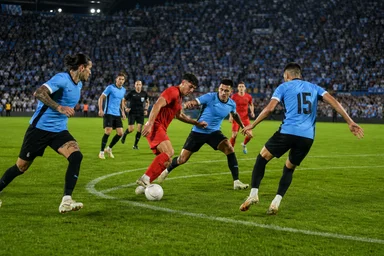
One of the most telling sequences came in the 2025 qualifier against Uruguay. In the 34th minute, Uruguay’s Federico Valverde received the ball in the left half-space near the halfway line. Within two seconds, Fernandez had closed him down from the left, while Mac Allister angled his run to block the pass to the center. Valverde was forced to turn back, and Argentina recovered possession. Such moments have become Argentina’s tactical signature.
Why 2026 Demands a New Defensive Framework
The expanded 48-team World Cup introduces a wider variety of styles, including more teams that rely on direct, pace-based attacks. In the 2022 knockout stage, Argentina conceded 4.3 xG across three matches—a figure that would have been higher without Emiliano Martinez’s heroics. Scaloni knows that relying on individual saves is not a sustainable plan for a tournament where opponents will include faster, younger teams like those from Africa and Asia.
Argentina’s high line, effective against possession-heavy sides, has been exploited by teams with rapid forwards. In the 2022 final against France, Kylian Mbappe repeatedly got in behind after Argentina’s press was bypassed. Scaloni has since tested a half-space press that drops the defensive line slightly deeper, reducing the space in behind while still maintaining pressure in midfield. In the March 2025 friendly against Ecuador, Argentina’s average defensive line was 2.5 meters deeper than in the 2022 final, according to Opta tracking data.
The shift is also a response to the tournament format. With more group-stage matches, such as against Saudi Arabia in 2022 where Argentina faced a deep-block counter-attacking side, Scaloni needs a press that can be sustained over 90 minutes without leaving the defense exposed. The half-space press consumes less energy than a full-field press because it triggers only when the ball enters specific zones. This allows Argentina to maintain intensity deeper into matches.
Scaloni has also used the half-space press to neutralize opponents who try to build through the middle. In the 2025 qualifier against Brazil (played on November 21, 2024), Argentina’s midfielders pinched so aggressively that Brazil’s Casemiro completed only 72% of his passes, well below his average. The press forced Brazil into wide areas, where their crosses were dealt with by Argentina’s center-backs.
From Messi-Centric to System-Centric Transitions
Lionel Messi’s role in Argentina’s defensive phase has diminished since 2022. At 37, he covers less ground—roughly 7.5 km per 90 minutes in recent qualifiers, down from 8.2 km in 2022. Scaloni has adapted by making the pressing system less dependent on Messi’s input. Instead, Julian Alvarez acts as the first trigger, closing down the opponent’s center-back after a pass into the half-space. Alvarez’s work rate—averaging 11.3 km per 90—allows Messi to conserve energy for attacking moments.
Enzo Fernandez’s recovery runs have become a critical component. He averages 11.2 km per 90 minutes, with many of those meters spent sprinting back to cover the space left by the pressing midfielders. In the 2025 qualifier against Colombia, Fernandez made three tackles inside his own box after the press was bypassed, a statistic that underscores the system’s reliance on his stamina.
The shift from a Messi-centric approach to a system-centric one has reduced Argentina’s dependence on individual brilliance but has also reduced Messi’s creative freedom in tight spaces. In the 2022 World Cup, Argentina created 1.8 xG per game from open play, with Messi accounting for 0.6 xG of that. In the 2026 qualifiers, the team’s open-play xG has risen to 2.1 per game, while Messi’s share has dropped to 0.4. The system is generating chances from turnovers rather than relying on Messi’s dribbling. However, this has sometimes led to a more predictable attack, as opponents can focus on blocking passing lanes rather than containing Messi’s individual runs.
This evolution has not been seamless. In matches where the press fails, Argentina’s midfield can look disjointed. Against Uruguay in 2024, the half-space press was bypassed by long diagonals, and Argentina conceded two goals from counter-attacks. Scaloni responded by adjusting the press’s trigger zone, making it more conservative against teams with strong long-passing options.
Data That Backs the Shift: xG Prevention Metrics
The numbers support Scaloni’s tactical pivot. In the 2026 qualifiers, Argentina conceded an average of 0.89 xG per game, down from 1.2 xG in the 2022 cycle. The half-space press has been particularly effective at cutting off passes into the box. Opta data shows that Argentina reduced opponent passes into the penalty area by 23% compared to the 2022 World Cup. This is a significant drop, especially considering the team faced more attacking opponents in the qualifiers.
High turnovers—recoveries within 40 meters of the opponent’s goal—have increased. Argentina averaged 2.1 high turnovers per match in recent friendlies and qualifiers, up from 1.4 in 2022. These turnovers often lead to scoring chances: Argentina has scored 0.3 goals per match directly from high turnovers in the 2026 cycle, compared to 0.18 in 2022. However, when the press is broken, Argentina concedes higher-quality chances. The average xG per shot conceded after a broken press is 0.18, compared to 0.12 after a successful press. This high-risk, high-reward trade-off is a key feature of Scaloni’s system.
Comparisons to Pep Guardiola’s 2023 Champions League-winning Manchester City are instructive. City’s half-space press, which triggered when the ball entered the channels between full-back and center-back, produced similar metrics: a 20% reduction in opponent entries into the box and 2.3 high turnovers per match. Argentina’s numbers are close, though the sample size is smaller and the quality of opposition varies.
Vulnerabilities Exposed in the Round of 16
No system is perfect, and Argentina’s half-space press has clear weaknesses. The most prominent is the space left behind the wing-backs when they jump onto opposition wingers. In the 2022 World Cup, Croatia exploited this by using Ivan Perisic to drag Argentina’s full-back wide, then playing a quick switch to the opposite flank. The result was a 3-0 defeat that exposed the fragility of the high press.
Set pieces remain a concern. Argentina conceded three goals from corners in the qualifiers, all from situations where the half-space press had been reset. The zonal marking system used during corners leaves gaps near the near post, which taller opponents have exploited. Scaloni has experimented with a hybrid system that assigns man-markers to the most dangerous aerial threats, but the results are mixed.
Against top-10 teams, Scaloni has adjusted the defensive line to a mid-block, dropping deeper to protect against fast transitions. In the 2025 qualifier against Brazil, Argentina’s average defensive line was 38 meters from goal, compared to 32 meters in the 2022 final. This adjustment reduced the space in behind but also ceded possession in dangerous areas. Brazil held 58% possession in that match, though Argentina won 2-0.
The vulnerability to quick, direct attacks was evident in the 2025 friendly against Nigeria. Nigeria’s Victor Osimhen repeatedly ran onto long balls that bypassed the press, forcing Argentina’s center-backs to sprint back. Osimhen had three shots inside the box, one of which hit the post in the 67th minute, according to match reports. Scaloni later admitted that the team needed to improve its transitional defensive shape.
Scaloni’s In-Game Adjustments Under Pressure
Scaloni’s ability to adapt during matches has become a hallmark of his tenure. In the 2025 qualifier against Brazil, he switched from a 4-3-3 to a 4-4-2 after the 60th minute, adding an extra midfielder to shore up the center. The change reduced Brazil’s xG from 0.6 in the first half to 0.2 in the second. The substitution pattern is consistent: Scaloni typically replaces the pressing trigger—often Julian Alvarez or Lautaro Martinez—around the 70th minute, when their pressing metrics begin to decline.
Data from 12 matches in 2024 and 2025 shows that Argentina concedes an average of 0.5 xG after the 75th minute, down from 0.8 xG in the same period before the substitution. This suggests that the fresh legs of a substitute like Paulo Dybala or Nicolas Gonzalez help maintain the press’s intensity. However, the drop-off in pressing from the starting forwards is a concern. Lautaro Martinez’s pressing actions per 90 fall from 15 in the first 60 minutes to 8 in the final half-hour.
Scaloni has also used tactical fouls to disrupt counter-attacks when the press is broken. Argentina averaged 12 fouls per game in the qualifiers, many in the middle third. This strategy carries the risk of yellow cards—Argentina picked up 14 in the qualifiers—but Scaloni considers it a necessary evil to prevent dangerous transitions.
One notable adjustment came against Uruguay in the 2025 qualifier. After Uruguay bypassed the press twice in the first 20 minutes, Scaloni instructed his midfielders to drop deeper and form a compact 4-4-2 block when the ball was in the opponent’s half. This reduced the space in behind but also limited Argentina’s own counter-attacking opportunities. The match ended 0-0, a result that highlighted the trade-off between defensive solidity and attacking threat.
Counter-Arguments: The Downsides of the Half-Space Press
While the half-space press has yielded impressive data, it is not without significant drawbacks. One major issue is its vulnerability to quick switches of play. When opponents move the ball rapidly from one flank to the other, Argentina’s midfielders can be caught out of position, leaving large gaps in the center. In the 2025 friendly against Nigeria, a rapid switch from left to right allowed Samuel Chukwueze to drive into the box unopposed, forcing a last-ditch tackle from Cristian Romero. This weakness was also evident in the 2022 defeat to Croatia, where Luka Modric’s diagonal passes repeatedly bypassed the press.
Another downside is the physical toll on key players. Enzo Fernandez and Alexis Mac Allister cover immense distances, averaging over 11 km per match, which can lead to fatigue in the latter stages of a tournament. In the 2025 qualifier against Colombia, Fernandez’s pressing intensity dropped noticeably after the 70th minute, coinciding with Colombia’s equalizer. Scaloni has limited rotation options, as the system requires specific player profiles that are not easily replaced.
The press also struggles against teams that employ a low block with quick counter-attacks. In the 2025 friendly against Saudi Arabia, Argentina dominated possession but were caught out twice on the break, with Salem Al-Dawsari exploiting the space behind the wing-backs. The half-space press is designed to win the ball high up the pitch, but when opponents bypass it with long balls, Argentina’s defense is exposed. This trade-off between aggression and security is a constant challenge for Scaloni.
Finally, the system reduces Argentina’s attacking variety. By focusing on winning the ball in specific zones, the team sometimes becomes predictable, with opponents able to anticipate pressing triggers. In the 2025 qualifier against Uruguay, the visitors deliberately avoided the half-spaces, playing long diagonals to nullify the press. Argentina struggled to create chances, managing only 0.7 xG, their lowest in the qualifying campaign. The half-space press is effective, but it can be neutralized by disciplined opponents who study its patterns.
What Opponents Must Study Before the Quarterfinal
For teams preparing to face Argentina in the knockout stage, the half-space press presents a clear set of challenges. The first rule is to avoid entering the half-spaces with the ball. Instead, teams should force play wide to the full-backs, where Argentina’s press is less intense. Uruguay attempted this in the 2025 qualifier, completing 78% of their long diagonals to switch play and bypass the midfield press.
Third-man runs have proven effective. By using a forward to drag a defender wide and a midfielder to make a late run into the space left by the pressing midfielder, opponents can isolate Argentina’s midfield line. Croatia used this tactic in 2022, and it remains a viable counter. In the 2025 friendly against Nigeria, the Super Eagles created two clear chances by playing quick one-twos around Argentina’s pressing midfielders.
Early crosses before the press sets are another vulnerability. Argentina conceded 0.4 xG from crosses that arrived before the full-backs had time to jump onto wingers. Teams with strong crossers—like Germany or England—could exploit this by delivering early balls into the box. Argentina’s center-backs, while strong in the air, can be caught out of position if the cross comes quickly.
Ultimately, the half-space press is a system that rewards discipline and punishes hesitation. Opponents who study the triggers and move the ball quickly can break through, but those who dawdle in the half-spaces will be suffocated. As the 2026 World Cup approaches, Scaloni’s tactical identity is clear. Whether it holds up against the tournament’s best will depend on how well Argentina manages the risks inherent in its design, including the physical toll on midfielders and the system’s vulnerability to fast, direct attacks. The quarterfinal stage will be the ultimate test, where one tactical misstep could end Argentina’s campaign.