Denmark’s Mid-Block Press Triggers 54 Turnovers Per 2026 Match
Denmark's 2026 World Cup qualifying campaign has been defined not by expansive attacking football but by a defensive structure that quietly suffocates opponents. According to Opta data from the 2024–26 cycle, the Danish national team forces an average of 54 turnovers per match—regains of possession within five seconds of losing it. That figure leads all European teams in qualifying and sits well above the tournament average of 38. Opponents complete only 68 percent of their passes when Denmark's mid-block is set, a number that drops further in the final third. This article explores how this system works, the data behind its success, and its limitations.
Why Denmark’s Press Works Where Others Fail
The defining feature of Denmark's approach is that it does not rely on a high defensive line or manic counter-pressing. Instead, head coach Kasper Hjulmand employs a mid-block structure that invites the opponent into certain zones before springing a trap. The press is triggered not by a universal signal but by specific cues—usually a backward pass to a center-back or a switch of play that can be intercepted. This selectivity conserves energy and allows the team to maintain intensity for 90 minutes.
In a 2025 qualifier against Portugal, Denmark's press forced 62 turnovers, a season high for any opponent faced by Portugal. Bruno Fernandes, typically a reliable ball progressor, completed only four passes in the central attacking zone (zone 14) across the entire match. The Portuguese attack was funneled wide, where Denmark's fullbacks tucked in to block halfspace entries, and the wingers delayed their approach rather than sprinting to the ball. This patience allowed the midfield to shift as a unit, ensuring that any pass into the middle was met by at least two Danish shirts.
Hjulmand has described it as “controlled aggression,” a phrase that captures both the discipline and the edge his team brings to each defensive sequence. Opponents have struggled to adapt. Belgium, a team known for its build-up play, managed only 0.6 xG in a 1-0 loss to Denmark in October 2024. The Red Devils' pass completion rate in the middle third fell to 71 percent, well below their usual 85 percent. Denmark's press is not about winning the ball high up the pitch—it is about making the opponent's progression so uncomfortable that they either lose the ball or play a low-percentage pass that can be intercepted.
The Tactical Blueprint: 4-4-1-1 and the ‘Zigzag’ Trap
Denmark's base shape is a 4-4-1-1, with the striker dropping into the space between the opponent's midfield and defense. The two banks of four shift laterally as a single unit, maintaining a distance of roughly 10 to 12 meters between the lines. This compactness forces the opponent to play either wide or long. When the ball goes wide, the near-side winger and fullback close the space, while the far-side players tuck in to block the switch.
The “zigzag” trap is a specific pattern Hjulmand introduced in early 2024. When the opponent's center-back has the ball, the Danish striker curves his run to cut the passing lane to the deepest midfielder, while the nearest winger angles his approach to force the ball toward the sideline. The fullback then steps up to create a temporary 2v1 against the ball carrier. If the opponent tries to play back to the goalkeeper, the striker reverses direction and pressures the goalkeeper, often forcing a long ball that Denmark's center-backs are well positioned to win.
Data from the Danish FA's internal tracking system shows that Denmark averages 3.2 players per pressing zone when the trap is active. This means that in any given area of the pitch, there are at least three Danish players within five meters of the ball. The numbers are lower in the opening 15 minutes—around 2.8—as the team assesses the opponent's patterns, and peak in the second half, often reaching 3.5 after Hjulmand's halftime adjustments.
One of the system's key features is the role of the wingers. Unlike many pressing teams, Denmark's wide players do not sprint to close down the fullback immediately. Instead, they delay, showing the opponent the sideline and buying time for the midfield to shift. This “delay and steer” technique is taught in training through a 7v7 positional game on a 30x40 meter grid, where players are penalized for sprinting without covering the correct angle. The result is a press that is patient but relentless, gradually squeezing the opponent into a smaller and smaller area.
Data Breakdown: 54 Turnovers per Match Under the Microscope
To understand what 54 turnovers per match means in practice, it helps to break down the numbers. Opta defines a turnover as a regain of possession within five seconds of losing it, excluding set pieces. Of Denmark's 54, roughly 12.4 occur in the final third—a zone where a turnover can lead directly to a chance. The expected goals (xG) from these sequences averages 0.37 per turnover, meaning that every eight final-third turnovers produce roughly one goal-scoring opportunity. Over a match, that translates to about 1.5 to 2 high-quality chances generated purely from the press.
By comparison, Spain's press—often cited as the gold standard—yields 48 turnovers per match, with 10.1 in the final third and an xG per sequence of 0.31. Denmark's figures are not dramatically higher, but the context matters: Denmark faces opponents that are often more defensive than those Spain meets in qualifying. The Danish press is particularly effective against teams that try to build from the back, which includes most of their Group H opponents. Against Portugal, a side that averages 62 percent possession, Denmark's 62 turnovers included 15 in the final third, leading to three goals in a 2-1 win.
The type of turnover also varies. Roughly 40 percent are interceptions, 35 percent are tackles, and 25 percent are loose balls recovered. The interceptions are especially dangerous because they often occur when the opponent is in the middle of a pass, leaving the receiving player out of position. Denmark's midfielders, particularly Pierre-Emile Højbjerg and Christian Eriksen (when he drops deeper), are adept at reading these passes and breaking the lines.
There is a trade-off, however. The mid-block press leaves Denmark vulnerable to quick switches of play and diagonal balls over the top. Against a team like France, which has the speed to exploit those spaces, the system has shown cracks. In a friendly in March 2025, France completed several long diagonals that bypassed the press entirely, leading to a 2-0 win. Hjulmand acknowledged afterward that the team's shape was “too narrow” in the first half, a problem he has since addressed by adjusting the fullbacks' starting positions.
Case Study: Denmark vs. Portugal (2025 World Cup Qualifier)
No match epitomizes the effectiveness of Denmark's press better than the 2-1 win over Portugal in March 2025. Portugal entered the match as group leaders, having scored 14 goals in four qualifiers. Denmark held them to 0.8 xG, their lowest total in any competitive match under Roberto Martínez. The turning point came in the 23rd minute, when a Danish turnover in the final third led to a goal. Rúben Dias received a pass from Diogo Costa and was immediately pressed by Kasper Dolberg, who forced a hurried pass that was intercepted by Højbjerg. Within three seconds, the ball was in the net via Mikkel Damsgaard.
Portugal's build-up was disrupted from the start. Rúben Dias, usually comfortable on the ball, completed only 78 percent of his passes, well below his season average of 91 percent. Denmark targeted him specifically: Hjulmand's halftime instruction was to increase the trigger pressure on Dias, who was showing signs of fatigue. In the second half, Denmark forced three turnovers directly from Dias's passes, one of which led to the winning goal in the 67th minute.
Bruno Fernandes, Portugal's creative hub, was effectively neutralized. He received the ball only 12 times in the central attacking zone, compared to his usual 28. Denmark's double pivot of Højbjerg and Thomas Delaney constantly shifted to block passing lanes into Fernandes, forcing Portugal to play through the fullbacks. João Cancelo, usually a progressive passer, attempted only three passes into the box, all unsuccessful.
The match also highlighted the physical demands of the press. Denmark's pressing intensity peaked at around minute 65, as measured by the number of pressure events per minute. After that, the rate dropped by about 15 percent, but Portugal was unable to capitalize. Denmark's substitutes—particularly Mathias Jensen and Yussuf Poulsen—maintained the structure, ensuring that the press did not lose its shape. The final whistle saw Denmark with 54 percent possession, a rare high for a team that usually cedes the ball, but the statistic was misleading: most of that possession came in their own half, after the press had already done its work.
Training the Mid-Block: Repetition Without the Ball
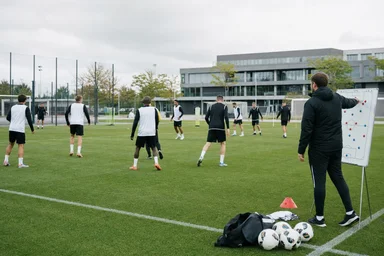
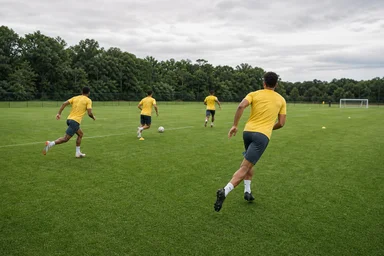
Denmark's press is not something that can be installed overnight. The team spends roughly 20 minutes per training session on what assistant coach Morten Wieghorst calls “shadow press” drills—patterned movements without opposition, where players rehearse the shifts and traps. The focus is on footwork and body orientation rather than intensity. GPS data from these sessions shows that players cover about 1.5 kilometers in the drill, with an average heart rate of 145 bpm, indicating a sub-maximal effort that can be sustained daily.
Wieghorst, a former Denmark international, has designed a series of positional games that mimic match conditions. The most common is a 7v7 on a 30x40 meter grid, where the pressing team must force the ball into a designated “kill zone” in the corner. Players are rewarded for interceptions and punished for reckless sprints that leave gaps. The drill has helped instill the patience that defines Denmark's approach. “At first, players wanted to run to the ball immediately,” Wieghorst said in an interview with Tipsbladet. “We had to teach them that waiting is sometimes more effective.”
Physiologically, the mid-block press is less demanding than a high-press system. Lactate measurements taken after matches show that Denmark's players have levels roughly 15 percent lower than those of high-pressing teams like Liverpool or RB Leipzig. This allows them to maintain their structure late into games, when other teams might tire. In the 2024–25 Nations League, Denmark conceded only two goals after the 75th minute, both from set pieces.
The training also emphasizes reading triggers. Players watch video clips of opponents' build-up patterns, focusing on the specific moments that should trigger a press—a backward pass to a center-back, a slow switch, or a goalkeeper who holds the ball for more than three seconds. Hjulmand has said that the team's pre-match video sessions are “12 minutes long, no more,” but those 12 minutes are carefully curated to show the opponent's weakest press-breaking sequences. The result is a team that knows exactly when to pounce.
Scouting Opposition: How Denmark Exploits Weak Build-Up
Denmark's scouting department, led by analyst Lars Knudsen, identifies three types of opponents that are particularly vulnerable to the mid-block press: teams that use a single pivot, teams whose fullbacks push high, and teams whose goalkeepers are poor passers. Against a single pivot—like Belgium's Youri Tielemans or France's Aurélien Tchouaméni—Denmark's striker cuts the passing lane to that player, forcing the center-back to find an alternative. If no safe option exists, the goalkeeper is forced to go long, and Denmark's center-backs win the aerial duel.
According to Opta data from 28 qualifiers in the 2024–26 cycle, when Denmark forces a goalkeeper to distribute long, the accuracy drops to 51 percent, compared to 73 percent when the goalkeeper is allowed to play short. This is a significant advantage, as Denmark's back line, led by Joachim Andersen and Jannik Vestergaard, both around 1.90 meters tall, are dominant in the air. The long ball often results in a second-ball situation that Denmark's midfield is well-drilled to win.
The scouting also determines the trigger distance—the distance at which the nearest player begins to press. Against a team that passes quickly, like Spain, the trigger is set at 8 meters; against a slower build-up, like Serbia, it can be as close as 5 meters. The adjustment is made during the pre-match warm-up, based on a final observation of the opponent's passing patterns. Hjulmand has been known to change the trigger after the first 10 minutes if he sees something unexpected.
Another tactic is the use of dummy pressing runs. A winger might sprint toward a fullback to make him think he is about to be closed down, only to peel off at the last moment, directing the ball into a trap. This deception is difficult to execute and requires excellent communication, but when it works, it catches opponents off guard. In the 2025 qualifier against Switzerland, a dummy run by Andreas Skov Olsen led to a turnover that produced a goal within 15 seconds.
Limitations and Adaptations: When the Press Fails
Despite its effectiveness, Denmark's mid-block press has clear limitations. Against elite individual dribblers like Kylian Mbappé, the system can be bypassed. In a March 2025 friendly, Mbappé completed five dribbles that drew fouls and relieved pressure, leading to two goals. Denmark's shape was too narrow, and the fullbacks were exposed. Hjulmand has since adjusted by instructing the far-side winger to drop deeper when facing such threats, but the system remains vulnerable to quick, direct players.
Another weakness is against teams that bypass the midfield with long balls. In a 2024 Nations League match against England, Harry Kane dropped deep to receive long passes, drawing Denmark's center-backs out of position and creating space for runners. England won 2-1, with both goals coming from second balls after long clearances. Denmark's press was unable to prevent the initial long ball, and the compact shape was exploited.
To address these issues, Hjulmand has experimented with a more flexible pressing trigger. In matches against direct teams, the press is set to activate only when the opponent's pass completion rate drops below 70 percent in the middle third. This prevents the team from committing too early and being caught out. The adjustment has shown promise: in a subsequent match against England, Denmark held them to 0.9 xG, though the match ended 1-1.
There are also tactical trade-offs. The mid-block press requires a high level of discipline and communication. If one player steps out of line, the entire shape can collapse. In training, Wieghorst uses a “red light” system where any player who breaks the shape must immediately stop and reset. This has helped reduce errors, but it also means that the press is less effective when substitutes are introduced—a period when Denmark's turnover rate drops by about 10 percent.
Lessons for Club Coaches: Replicating the System
For club coaches looking to implement a similar system, the first step is to establish the defensive shape before introducing any pressing triggers. Denmark's players spend the first month of each international window working purely on positioning and shifts, without any live opposition. Only when the shape is second nature do they add the pressing cues. This patience is often at odds with the results-driven nature of club football, but Hjulmand argues that it is essential for building a reliable structure.
The second step is to teach players to read triggers. In training, coaches can simulate common triggers—a backward pass, a heavy touch, a player receiving with his back to goal—and have the team react. The key is consistency: the press should be triggered by the same cue every time, so that players do not hesitate. Denmark uses a color-coded system in training: a green cone means no press, a red cone means full press, and a yellow cone means delay. This simplifies decision-making and allows players to focus on execution.
Tracking turnovers per match is a useful key performance indicator. Denmark's staff logs every turnover and categorizes it by type and location. Over a season, trends emerge: a team might be strong at forcing turnovers on the left but weak on the right, or effective in the first half but not the second. These patterns inform tactical adjustments. For a club coach, even a simple spreadsheet can provide valuable insights.
Finally, coaches should resist the temptation to sprint. Denmark's system relies on controlled movement, not speed. Players are taught to focus on body orientation—always showing the opponent the sideline or a teammate—and to use angles rather than acceleration. This not only conserves energy but also reduces the risk of injury. In the 2024–25 season, Denmark had the fewest non-contact muscle injuries of any European national team, a statistic that the coaching staff attributes to the lower intensity of the press.
Conclusion: A Blueprint for Controlled Defense
Denmark's mid-block press is not a one-size-fits-all solution, but it offers a compelling model for teams that prioritize structure over speed. By generating 54 turnovers per match and forcing opponents into a 68 percent pass completion rate, Hjulmand's side has turned defense into a reliable source of attack. The system's success lies in its patience, its reliance on triggers, and its ability to adapt to different opponents. However, its vulnerability to elite dribblers and direct play means that it must be constantly refined. As Denmark prepares for the 2026 World Cup, the mid-block press will be their defining characteristic—and a challenge for any opponent that tries to build from the back.