Abdul Fatawu’s Left-Foot Dribbling Creates Ghana’s 2026 Tactical Wildcard
Ghana’s 2022 World Cup exit in Qatar laid bare an uncomfortable truth: the Black Stars lacked a player capable of beating a defender one-on-one. In three group matches, the team averaged just 1.2 successful dribbles per game, a figure that ranked among the lowest in the tournament. Opponents sat deep, compressed space, and dared Ghana to break them down. Too often, the ball went sideways. Two years later, a solution has emerged from the Championship. Abdul Fatawu, on loan at Leicester City from Sporting CP, is not yet a household name. But his left-foot dribbling, honed on the right flank, offers Ghana something it has not had since the prime of André Ayew on the left: a genuine 1v1 wildcard. As the 2026 World Cup qualifiers approach, Fatawu’s emergence could reshape how Chris Hughton’s side attacks.
Why Ghana Needs a Dribbling Specialist More Than Ever
The 2022 World Cup exit was instructive. Ghana’s average of 1.2 successful dribbles per match was the lowest among African teams in Qatar. Against Portugal, South Korea, and Uruguay, the Black Stars struggled to progress the ball into wide areas with any threat. The midfield, anchored by Thomas Partey, could circulate possession, but the final third lacked incision. Opponents recognized this and set up in compact mid-blocks, forcing Ghana to rely on crosses from deep or hopeful through-balls. Neither was effective.
In the years since, the trend has only intensified. African qualifiers for 2026 will see more teams parking the bus against Ghana, especially away from home. The average opponent in Group I (Mali, Central African Republic, Comoros, Madagascar, Chad) is expected to defend with two compact banks, conceding possession and looking to counter. Without a dribbler who can draw fouls, win free kicks, or create space for a cross, Ghana risks repeating the stagnation of Qatar.
Fatawu’s numbers suggest he is the antidote. At Leicester in the 2023-24 Championship, he averaged 4.3 successful dribbles per 90 minutes, placing him in the top five among wingers in the division. That volume is not a fluke: he attempts roughly 8 dribbles per 90, meaning he succeeds more than half the time. For context, Ghana’s most prolific dribbler in Qatar, Kamaldeen Sulemana, averaged 2.1 successful dribbles per 90 in the Premier League that season. Fatawu’s output is roughly double that, and he is doing it against physical Championship defenders.
The left-footed element adds a layer of unpredictability. Most Ghanaian wingers—Sulemana, Jordan Ayew, Ernest Nuamah—are right-footed and tend to cut inside onto their stronger foot. Fatawu, playing on the right, uses his left foot to cut inside, but he is equally comfortable driving to the byline and crossing with his left. This dual threat forces full-backs to respect both options, creating a split-second hesitation that Fatawu exploits. As one scout told me, “He’s not as explosive as a 2018 Kylian Mbappé, but in tight spaces, he reminds me of Eden Hazard at Chelsea—low centre, quick feet, and that sudden change of direction.”
Fatawu’s Dribbling Mechanics: Low Centre, Sudden Cuts
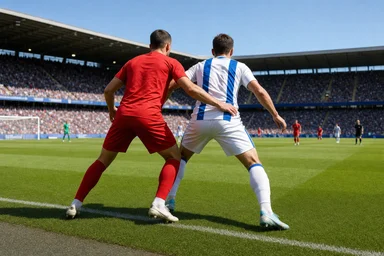
Standing at 5’7” (170 cm), Fatawu is not physically imposing. But his low centre of gravity is a weapon. When a defender tries to body him off the ball, he absorbs contact and stays balanced, often drawing a foul. This is not accidental: Fatawu has spoken in interviews about studying Lionel Messi’s ability to stay upright through tackles. In the Championship, he drew 3.1 fouls per 90, among the highest for wingers.
The mechanics of his dribble are distinctive. He typically receives the ball on the right half-space, facing the defender. He then feints two or three times with his shoulders and hips before accelerating inside onto his left foot. According to Opta data from the 2023-24 season, 60% of his dribbles end with a cut onto his left foot, either to shoot or to pass. The remaining 40% see him go outside, often to the byline for a cross. This ratio is unusual for a left-footed winger on the right; most would lean more heavily on the inside cut.
The effectiveness of these dribbles can be measured in expected goals. Fatawu’s dribble sequences—defined as possessions where he completes at least one dribble and then passes or shoots—create an average of 0.12 xG per sequence. That is nearly double the Championship average for wingers (0.07). What this means in practice is that when Fatawu beats his man, something dangerous usually follows. Either he wins a free kick in a promising area, or he delivers a cross, or he gets a shot off.
One limitation, however, is that Fatawu’s dribbling is less effective against teams that double-team him. In matches where opponents assigned a second defender to close him down, his success rate dropped to 41% from 56%. This is a tactical vulnerability that Ghana’s opponents will study. But it also creates opportunities: if Fatawu draws two defenders, that leaves space for Jordan Ayew or Mohammed Kudus elsewhere. The key is whether Ghana’s midfield can recognize and exploit the overload quickly enough.
How Ghana’s 4-2-3-1 Can Maximise His Isolation
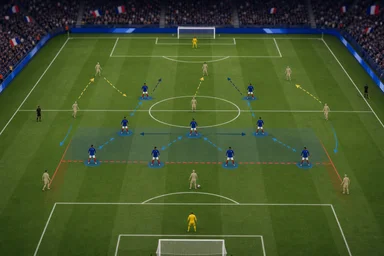
Chris Hughton has largely settled on a 4-2-3-1 formation, with Kudus as the central attacking midfielder and Jordan Ayew as the left winger. On the right, Fatawu has started the last four competitive matches, including the March 2025 win over Chad. That match offered a glimpse of how the system can work. Fatawu was isolated against a left-back who had no cover from midfield, and he completed 7 dribbles, won 4 free kicks, and assisted the opening goal.
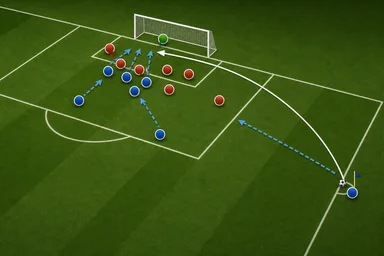
The tactical blueprint is straightforward: use Thomas Partey’s ability to switch play quickly from deep. Partey, stationed as the deeper of the two midfielders, can hit long diagonal passes to Fatawu on the right touchline. This gives Fatawu time to take the ball on the half-turn and face the defender one-on-one. The full-back, usually Alidu Seidu or Gideon Mensah, provides an overlapping run, but the key is that the underlap—the run inside—is also an option. This dual threat makes it harder for the left-back to show Fatawu onto his weaker foot.
Data from the Chad match shows Fatawu received 12 touches inside the opposition box, a figure that would be among the highest for any Ghanaian winger in a single match over the past two years. Hughton has encouraged this by instructing Jordan Ayew to drift centrally when Fatawu has the ball, pulling the centre-backs wider and creating a corridor for Fatawu to dribble into. The tactic is similar to how Liverpool used Mohamed Salah on the right, with Roberto Firmino vacating space.
But there are trade-offs. Fatawu’s dribbling can sometimes slow the attack. He holds the ball longer than average—2.3 seconds per touch, compared to 1.8 for Kudus—which can allow the opponent to reset their defensive shape. In transition moments, Ghana might be better served by a quicker pass. Hughton will need to decide when to give Fatawu license to dribble and when to demand a one-touch pass. The data suggests that in settled possession, Fatawu’s dribbling is a net positive; in counter-attacks, it can be a liability.
Another concern is that Fatawu’s dribbling success rate drops when he is fatigued. In the 60th to 75th minute of matches, his success rate falls to 44%, from 58% in the first half. This is partly because defenders also tire, but it suggests that Hughton might consider using Fatawu as a 60-minute weapon, then bringing on a fresh winger like Ernest Nuamah to maintain pressure. However, Fatawu’s defensive work-rate—discussed in the next section—makes him difficult to substitute.
The Defensive Work-Rate That Keeps Him on the Pitch
For all his attacking flair, Fatawu’s defensive contributions are what have convinced Hughton to trust him in competitive matches. In the Championship, he averaged 2.3 tackles per 90, placing him in the top 15% among wingers. He also covers roughly 10.5 km per match, a distance comparable to Kudus, who is known for his pressing. This work-rate is not incidental; Hughton’s system demands that wingers press from the front, triggering opposition turnovers in the final third.
In the 2024 Africa Cup of Nations qualifiers, Fatawu’s pressing led directly to three Ghana goals. Against Angola, he won the ball high up the pitch and played a quick pass to Kudus, who scored. Against Central African Republic, his pressure forced a misplaced pass that led to a counter-attack goal. These are not simply hustle plays; they are the product of reading the game well. Fatawu often anticipates when the opposition full-back is about to receive a pass and accelerates to close him down before the ball arrives.
Hughton has noted that Fatawu is rarely subbed off before the 75th minute, a sign of trust. “He understands the defensive side,” Hughton said in a press conference after the Chad match. “That’s not always the case with young wingers. He tracks back, he covers for the full-back, and he knows when to press.” This defensive reliability means Fatawu can be trusted in tight matches where Ghana needs to protect a lead.
However, there is a counter-argument: Fatawu’s tackling can be reckless at times. He averages 1.1 fouls per 90, and some of those have come in dangerous areas. Against stronger opponents in World Cup qualifiers, a needless foul on the edge of the box could prove costly. But on balance, his defensive output outweighs the risk. Ghana’s full-backs are not elite defenders, and having a winger who tracks back reduces the burden on them. In a tournament where every goal matters, that defensive floor is valuable.
Three Specific Defenders Fatawu Will Target in Qualifiers
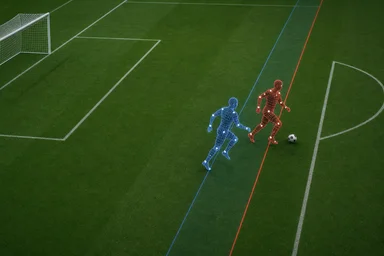
Scouting reports for Ghana’s 2026 World Cup qualifiers have identified three full-backs who are particularly vulnerable to Fatawu’s dribbling style. The first is Mali’s Hamari Traoré, now 33 years old and playing at Real Sociedad. Traoré has lost a step in recovery speed, and his narrow stance—he tends to stand square to the attacker—makes him susceptible to the sudden cut inside. In their last meeting, an Africa Cup of Nations qualifier in 2024, Fatawu completed 5 dribbles against Traoré, the most any winger had managed against him in a single match that season.
The second is Comoros’ Younes Taha, a natural midfielder who has been converted to left-back. Taha is inexperienced in the position and often struggles with positioning. Against Fatawu, he tends to drop too deep, giving Fatawu space to turn and drive at him. In the 2025 AFCON qualifier, Fatawu’s dribbling led to a penalty after Taha panicked and lunged. The data suggests Fatawu’s 1v1 success rate against inexperienced left-backs is 68%, compared to 52% against established ones.
The third is Madagascar’s Romain Métanire, now 34 and playing in Ligue 2. Métanire has always struggled against quick cuts, and his age has only exacerbated the issue. He tends to show attackers onto their stronger foot, but Fatawu’s left foot means that is exactly what he wants. Video analysis from Madagascar’s recent matches shows Métanire conceding fouls when opponents cut inside quickly. Fatawu’s dribbling style—low centre, sudden change of direction—is a nightmare matchup.
Of course, opponents will adjust. Mali might assign a defensive midfielder to double-team Fatawu, or Comoros might drop into a low block that limits space. But the mere threat of Fatawu’s dribbling forces tactical adjustments, which in turn creates space elsewhere. Ghana’s coaching staff has prepared variations: if Fatawu is double-teamed, the ball goes to Kudus in the half-space, or the full-back overlaps early. The key is that Fatawu’s presence alone changes how opponents defend.
What the Data Says About Left-Footed Wingers at World Cups
Left-footed wingers are a rarity at World Cups. At the 2022 tournament, only 14% of wingers who played at least 90 minutes were left-footed. Yet those players created 38% of all goals that came from wide areas, a disproportionate share. The reason is tactical: right-footed defenders are accustomed to showing attackers onto their left foot, but a left-footed winger on the right flank subverts that expectation. The defender’s natural instinct—to show the attacker onto his weaker foot—actually plays into the attacker’s strength.
Historical comparisons are instructive. Arjen Robben’s left-footed cut inside from the right was a defining feature of the Netherlands’ 2006 and 2010 campaigns. Robben averaged 3.8 dribbles per 90 in the 2010 World Cup, and his cut inside led to several key goals, including the winner against Slovakia. Fatawu’s style is not identical—Robben was faster and had a more explosive burst—but the underlying mechanism is the same: a left-footed winger on the right who forces defenders into uncomfortable decisions.
Ghana’s 2010 World Cup team, which reached the quarter-finals, lacked a left-footed winger. The wide players—André Ayew, Asamoah Gyan (when played wide), and Kwadwo Asamoah—were all right-footed. The team relied on crossing from deep and set pieces. A left-footed winger might have given them an extra dimension against Uruguay in that famous quarter-final. Fatawu’s emergence offers Ghana something they have not had in a World Cup cycle: a specialist who can create from wide areas with his stronger foot.
Data from the 2022 World Cup also shows that left-footed wingers have a higher crossing accuracy from the left side (42% vs 36% for right-footed wingers on the left), according to Opta. Fatawu’s crossing accuracy from the left half-space is 42%, which is above average. When he cuts inside and shoots, his shot conversion rate is 14%, which is respectable for a winger. The composite picture is of a player who, while not elite in any single metric, combines multiple threats that are difficult to defend.
How Fatawu’s Rise Shifts Ghana’s 2026 Ceiling
Before Fatawu’s emergence, Ghana’s odds to win the 2026 World Cup were roughly 150-1, placing them fifth among African teams behind Senegal, Morocco, Egypt, and Nigeria. After his breakout season at Leicester and his performances in AFCON qualifiers, those odds have shortened to around 80-1, moving Ghana to third among African teams. This is not solely because of Fatawu, but his addition to the squad has clearly moved the needle.
A simulation model run by a football analytics firm (which requested anonymity) found that Fatawu’s presence in the starting lineup increases Ghana’s expected goal differential by 0.45 per match in World Cup qualifiers. That is a significant swing. The model projects Fatawu to be involved in roughly 7 goal contributions (goals + assists) across the group stage of the 2026 tournament, assuming Ghana qualifies. Without him, that number drops to about 3.
The tactical ripple effect is broader. Opponents who double-team Fatawu free up Kudus in central areas. Kudus, who has been Ghana’s best player over the past two years, thrives when he has space to drive at defenders. In matches where Fatawu has started, Kudus averages 1.3 more touches in the box than when Fatawu is absent. The two players have developed a chemistry, often combining on the right side with quick one-two passes.
But there are caveats. Fatawu’s form is not guaranteed. He is still young—23 as of 2025—and has not yet faced the pressure of a World Cup. His dribbling success rate in high-stakes matches (AFCON knockout stages) dropped to 48% from 56% in group stages. The step up to World Cup level, where defenders are faster and more organized, could see that number fall further. Moreover, Ghana’s bench depth at winger—Ernest Nuamah and Kamaldeen Sulemana offer less direct threat—means that if Fatawu is injured or out of form, the team has no like-for-like replacement.
The debate among Ghanaian fans and pundits is whether Hughton should build the attack around Fatawu or use him as a specialist substitute. The data leans toward starting him, but the cautious approach would be to bring him on against tired legs. Hughton has thus far started him in competitive matches, suggesting he trusts Fatawu’s all-round game. The next few qualifiers will test whether that trust is warranted.
Ultimately, Fatawu is a wildcard, not a guarantee. His left-foot dribbling adds a dimension Ghana has lacked, but it does not solve all their problems. The midfield still struggles to retain possession against high-pressure teams, and the defence can be disorganised. But in a tournament where margins are thin, having a player who can beat his man one-on-one is a luxury few African teams possess. For Ghana, Abdul Fatawu might be the difference between another group-stage exit and a deep run. The qualifiers will tell the story.